
The Scissortail Brief | Week of Feb 9-15
This week in U.S. business aviation brought major fleet expansion commitments, steady year-over-year activity gains, new FAA operational guidance, early movement on certification reform in Washington, surprise airspace restrictions, and continued rollout of digital planning and cost analysis tools. Together, the developments reflect a market defined by stable demand, evolving oversight, and increasing operational sophistication across charter, fractional, and corporate flight operations.
The Scissortail Brief | Week of Feb 1 - 8
From FAA funding and new cockpit voice recorder requirements to Super Bowl airspace restrictions and early findings in the Citation II accident investigation, the first week of February brought a steady stream of developments for business aviation. The Scissortail Brief pulls together the key regulatory, operational, and industry updates from Feb. 1 through Feb. 8 so operators can stay informed without chasing every headline.

Business Aircraft Financing in 2026
Business aircraft financing in 2026 is active, selective, and far more disciplined than it was just a few years ago. This Knowledge Hub column breaks down who’s lending, how deals are getting underwritten, and what terms and rates actually look like in today’s market, with a clear-eyed look at where capital is flowing and what buyers need to have lined up to get transactions across the finish line.
The Scissortail Brief | Jan 25-31
This week’s Scissortail Brief leads with the deadly Challenger 650 crash in Bangor and the early stages of the federal investigation, followed by President Trump’s threat to decertify Bombardier aircraft over stalled Gulfstream approvals in Canada. The briefing also includes new FAA passenger guidance, agency reorganization, fuel pricing movement, and upcoming Super Bowl airspace restrictions.

When a Dry Lease Isn’t Dry: How FAA Inspectors Really Judge an Aircraft Dry Lease
I have spoken with current and former FAA inspectors who spent years reviewing dry lease operations in the field. They are the ones who review the paperwork, walk through how flights are conducted day to day, and decide whether an operation holds together as a legitimate dry lease or starts to resemble something else. This article reflects the patterns they see repeatedly when documents, control, and real-world conduct are compared.
The Scissortail Brief - Week of 1/19
Introducing the Scissortail Brief, a weekly snapshot of the forces shaping U.S. business aviation, from regulatory decisions and fuel market shifts to new aircraft entering service and changes in how and where operators fly. Each edition cuts through the noise to highlight what matters most to operators, owners, and industry leaders, pairing timely updates with practical context so you can anticipate impacts, adjust plans, and move forward with confidence.

Greenland: Is Your Aviation Strategy Prepared for Geopolitical Volatility?
Business aviation stakeholders often think in terms of aircraft performance, operating cost, and asset utilization. But Greenland's situation brings another, often-overlooked and taken-for-granted, variable into focus: the geopolitical stability of the free world. A forced annexation becomes more than a diplomatic provocation. It becomes a stress test for a deeply interconnected industry. When assumptions about rule of law, treaty durability, and economic cooperation begin to unravel, the effects cascade through aviation ecosystems faster than many planning models account for.

How Business Aviation Consulting Improves Operational Efficiency
Cost control is often a primary driver for engaging consulting support. Reducing expenses in business aviation does not require cutting safety margins or limiting capability. Instead, it requires identifying inefficiencies that increase costs without providing operational value. These inefficiencies frequently appear in maintenance planning, vendor relationships, resource utilization, and budgeting processes. By applying private aviation management expertise, consultants help flight departments align spending with actual operational needs, resulting in improved cost predictability and stronger financial control.

Just Culture in Business Aviation and Its Impact on Flight Department Safety
At its core, just culture is about how an organization responds to human error, at-risk behavior, and intentional misconduct. The FAA defines just culture as an environment where individuals are encouraged to report safety concerns and mistakes without fear of unfair punishment, while still holding people accountable for reckless or intentional violations. The objective is not to remove accountability, but to apply it in a way that supports learning and improvement rather than silence.

Reducing Corporate Flight Department Costs Without Compromising Safety
Reducing corporate flight department costs starts with recognizing the connection between safety and efficiency. Inefficient processes often create conditions that increase both cost and risk. Reactive decision-making, compressed schedules, and unclear responsibilities add pressure to daily operations and increase the likelihood of error. Improving structure and predictability reduces unnecessary expense while supporting safe outcomes.

A Guide to Federal Contracting for Aerospace Startups
Understanding federal contracting begins with recognizing how government procurement differs from commercial business development. Federal agencies operate within structured regulatory frameworks designed to ensure transparency, competition, and accountability. Aerospace startups that understand these frameworks and prepare accordingly are far better positioned to compete effectively.

How Artificial Intelligence Can Increase a Flight Department’s Efficiency
Flight departments manage complex systems that generate large volumes of data. Scheduling, maintenance tracking, crew management, safety reporting, and cost control all rely on accurate information and timely decisions. As operational complexity increases, relying solely on manual processes and individual experience becomes more challenging. AI-driven tools can support flight departments by identifying patterns, highlighting risks, and improving coordination across functions.
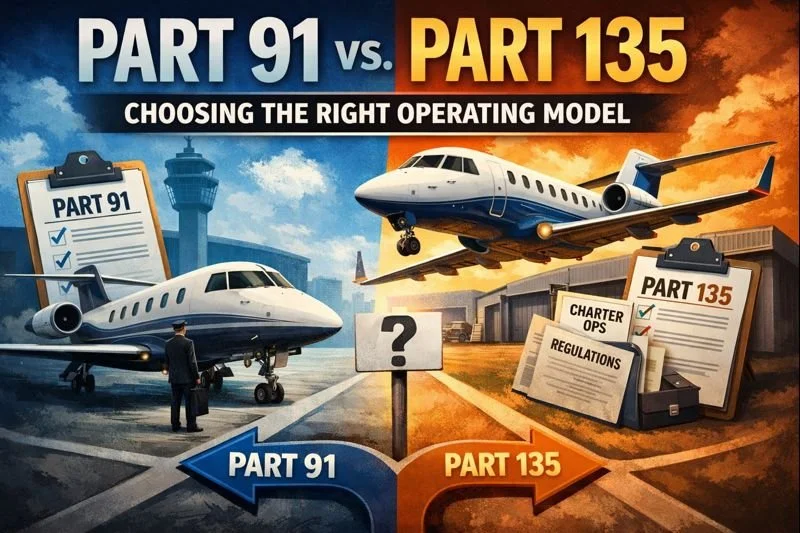
Part 91 vs. Part 135: Choosing the Right Operating Model
Understanding the distinction between Part 91 vs Part 135 begins with the role of compensation and operational control. Part 91 governs non-commercial operations conducted in support of an owner’s internal business or personal needs. Part 135 governs commercial on-demand operations where transportation is provided to others for compensation or hire. The difference is not philosophical. It is regulatory, enforceable, and closely scrutinized by the FAA.

FAA Compliance for Business Aviation: What Operators Need to Know Before Crossing the Line
FAA compliance should be viewed as a strategic consideration rather than a regulatory obstacle. When regulatory requirements are understood and integrated effectively, they support safer operations, clearer governance, and long-term sustainability. For operators operating near the boundary between Part 91 and Part 135, compliance clarity protects both the organization and its leadership.
How to Prepare Your Flight Department for an FAA Audit
Aviation compliance consulting can be valuable during audit preparation, particularly for flight departments with limited internal bandwidth or those facing new oversight. An objective review helps identify gaps before the FAA does and allows corrective action to be taken on the operator’s timeline rather than during an inspection. Even limited outside perspective can provide clarity and reduce stress.

Vendor Management in Business Aviation: Getting Better Value from MROs and Service Providers
Many vendor management challenges arise not from poor intent, but from limited internal bandwidth. Flight departments are focused on execution, leaving little time for strategic review of vendor performance. Periodic evaluation provides an opportunity to reassess relationships, adjust expectations, and confirm that services continue to meet operational needs.

Scaling a Business Aviation Operation Without Increasing Risk
Private aviation operations that scale successfully share a common approach. They anticipate change, assess risk deliberately, and adjust systems before problems emerge. Growth is treated as a controlled process rather than an organic expansion. This mindset reduces disruption and supports sustainable performance.

Data-Driven Decision Making in Modern Business Aviation
One of the challenges in adopting analytics is data quality. Inconsistent recordkeeping, fragmented systems, or incomplete reporting limit the usefulness of analysis. Improving data discipline enhances confidence in the insights derived and supports better long-term outcomes. Clear definitions and consistent entry practices are essential.

What Business Aircraft Owners Should Expect from an Aviation Consulting Partner
Accountability is essential. A strong aviation consulting partner helps establish measurable outcomes and supports follow-through. This may include improved compliance alignment, reduced operational risk, or increased efficiency. Consulting engagements that end with a report but no path forward often deliver limited value.

What Family Offices and Corporate Flight Departments Get Wrong About Private Aviation Strategy
Private aviation can be a game-changer when the strategy behind it really fits your needs. This piece looks at a few common ways flight departments and family offices drift off course, and how small adjustments can make a big difference in efficiency, cost, and peace of mind.