
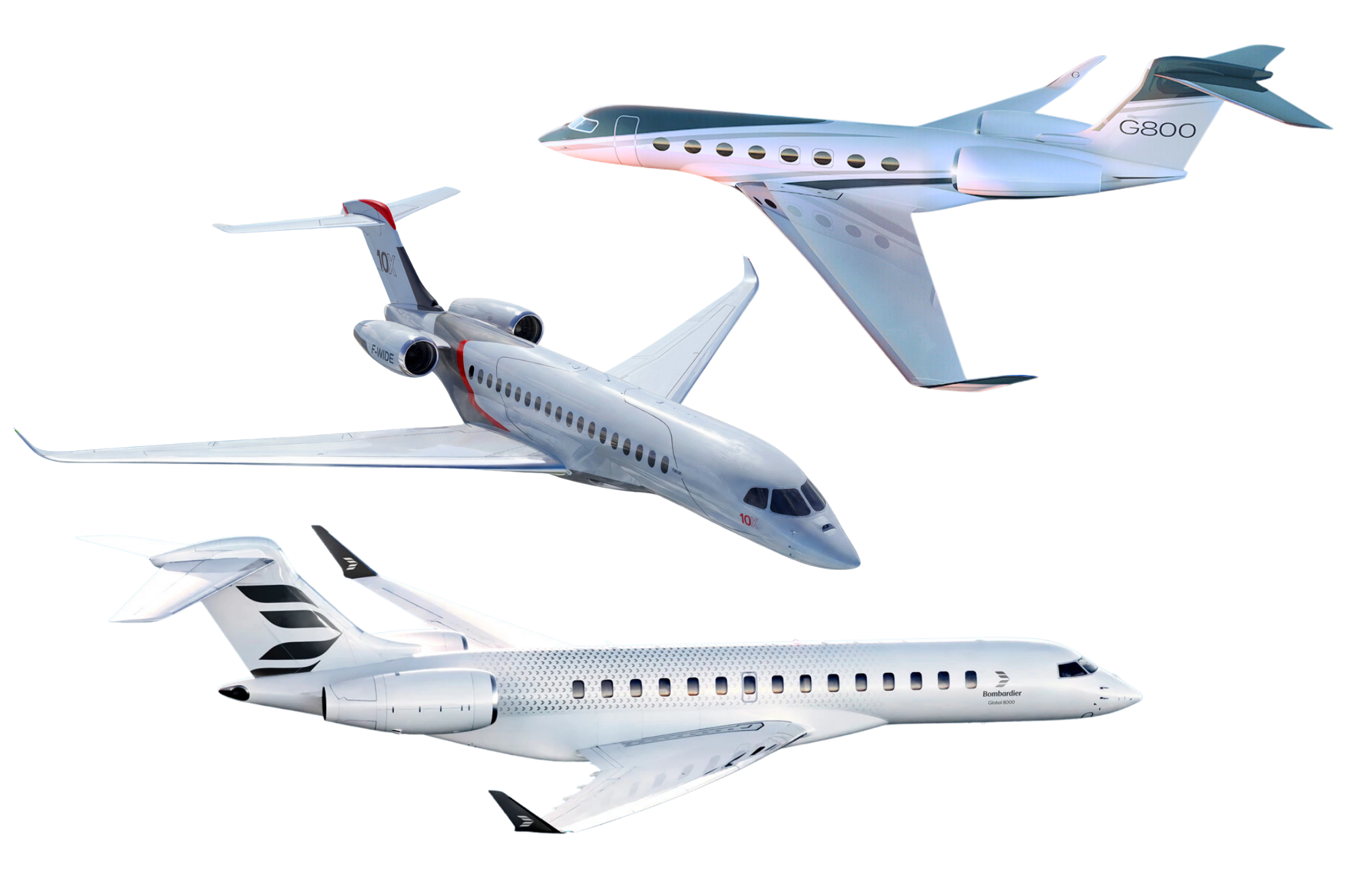
Gulfstream G800 | Dassault Falcon 10X | Bombardier Global 8000
Falcon 10X vs. Bombardier Global 8000 vs. Gulfstream G800
An In-Depth Comparison of the Three Leading Ultra-Long-Range Business Jets
Introduction
The ultra-long-range large-cabin segment of the business jet market has three serious competitors entering or currently in service at the same time, and that hasn't happened at the top of this market in a long time. The Gulfstream G800 received FAA and EASA certification in April 2025 and began deliveries in August. The Bombardier Global 8000 earned Transport Canada type certification in November 2025, FAA certification in December, and delivered its first aircraft that same month. The Dassault Falcon 10X rolled out publicly in March 2026 at Bordeaux-Merignac and is on track for first deliveries in 2027.
All three are priced within roughly $10 million of each other, all three are aimed at the same buyers, and all three carry enough genuine differentiation that the choice between them is not obvious. This piece examines each aircraft in depth, then lays them side by side across the dimensions that matter most for actual purchase decisions.
A note on the data: the G800 and Global 8000 are certified and in service, so their performance numbers are confirmed. The Falcon 10X is still in its certification campaign as of this writing. Dassault's published specs are manufacturer projections. Where that distinction is relevant to the analysis, it is noted explicitly.
I: Dassault Falcon 10X
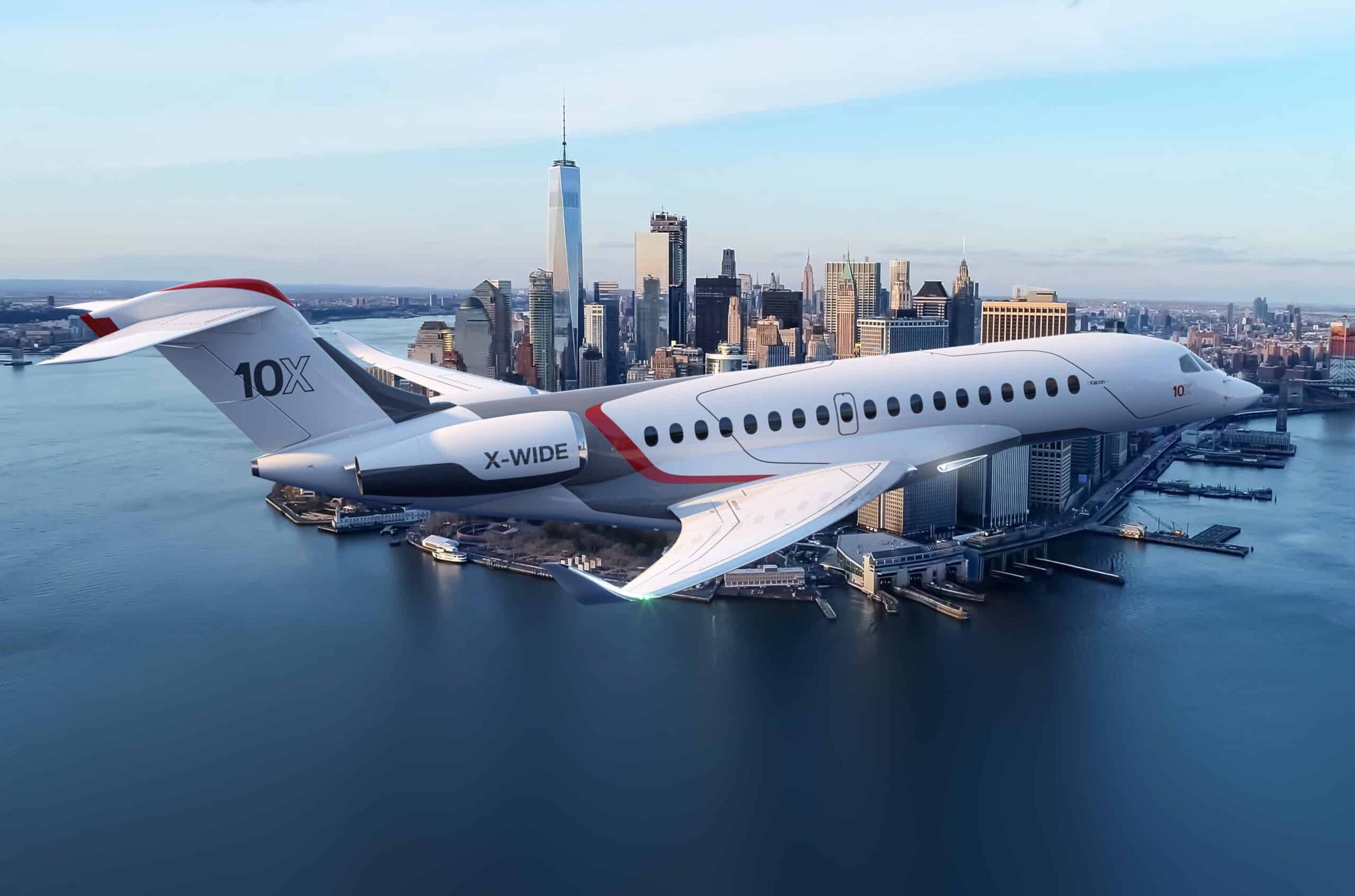
© Dassault Aviation
Background
Dassault Aviation announced the 10X in May 2021, during a period when the private aviation market was seeing some of the strongest demand in its history. The 10X is a clean-sheet design, the most ambitious business jet Dassault has ever built, and it's targeted directly at the top of the ultra-long-range segment. The public rollout took place on March 10, 2026, in Bordeaux-Merignac before more than 400 customers and industry guests. First deliveries are scheduled for 2027, approximately two years behind the original 2025 target—a slip that is common in clean-sheet programs of this complexity.
Dassault's case for the 10X rests on two pillars: the widest cabin in the category, and airport access that no other aircraft in the comparison can match. Everything else about the aircraft is competitive with or better than the field; these two things are exclusive to the 10X.
Performance
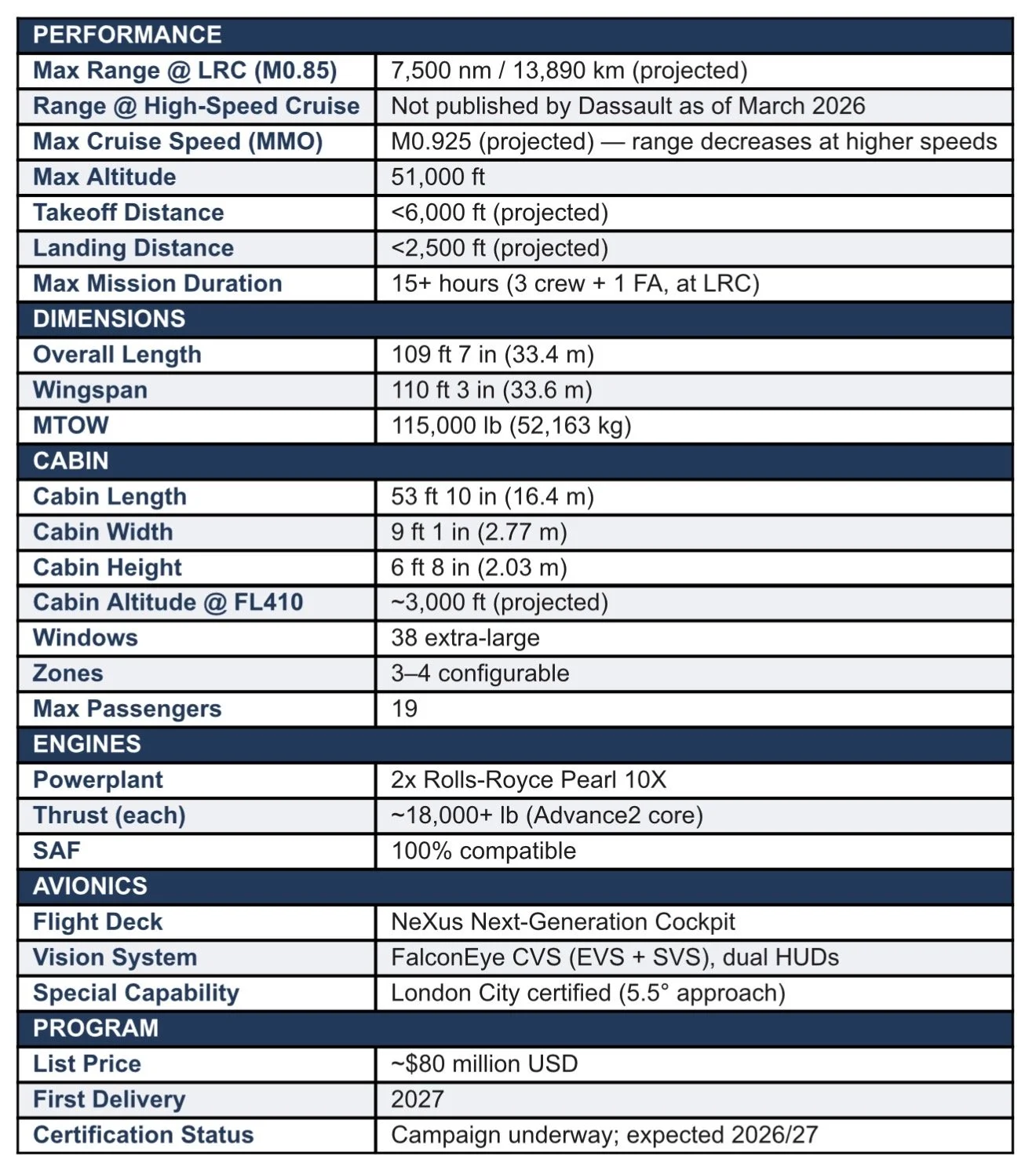
Dassault projects the 10X at 7,500 nm range at long-range cruise, roughly Mach 0.85, a maximum cruise speed of Mach 0.925, and a service ceiling of 51,000 feet. Like its competitors, the 10X does not achieve its maximum range at its maximum speed—those are two separate numbers that represent opposite ends of the performance envelope. Dassault has not published a high-speed range figure for the 10X as of this writing. The 7,500 nm projection is the LRC maximum, and range decreases as cruise speed increases. The range figure is the shortest of the three aircraft in this comparison by 500 to 700 nm at LRC. On missions of 7,500 nm or less, that gap is irrelevant. On certain Pacific or transoceanic routes—New York to Hong Kong is approximately 8,054 nm, Los Angeles to Sydney is roughly 7,487 nm—the 10X operates at or beyond its range limit where the other two aircraft have margin to spare.
Where the 10X separates itself from both competitors is field performance. The all-composite wing delivers a projected takeoff distance under 6,000 feet and a landing distance under 2,500 feet. Dassault has obtained London City Airport certification for the 10X. London City requires a 5.5-degree approach angle and a runway of around 4,900 feet. Neither the G800 nor the Global 8000 is London City certified. For operators whose missions include LCY or other constrained European or mountainous airports, that is an exclusive operational capability.
As noted above, all 10X performance figures are manufacturer projections pending certification. The G800's certified range came in 200 nm above its initial projection; the Global 8000's certified numbers aligned closely with Bombardier's targets. Dassault's track record on projections has been reliable, but buyers should treat 10X specs as targets until certification confirms them.
Cabin
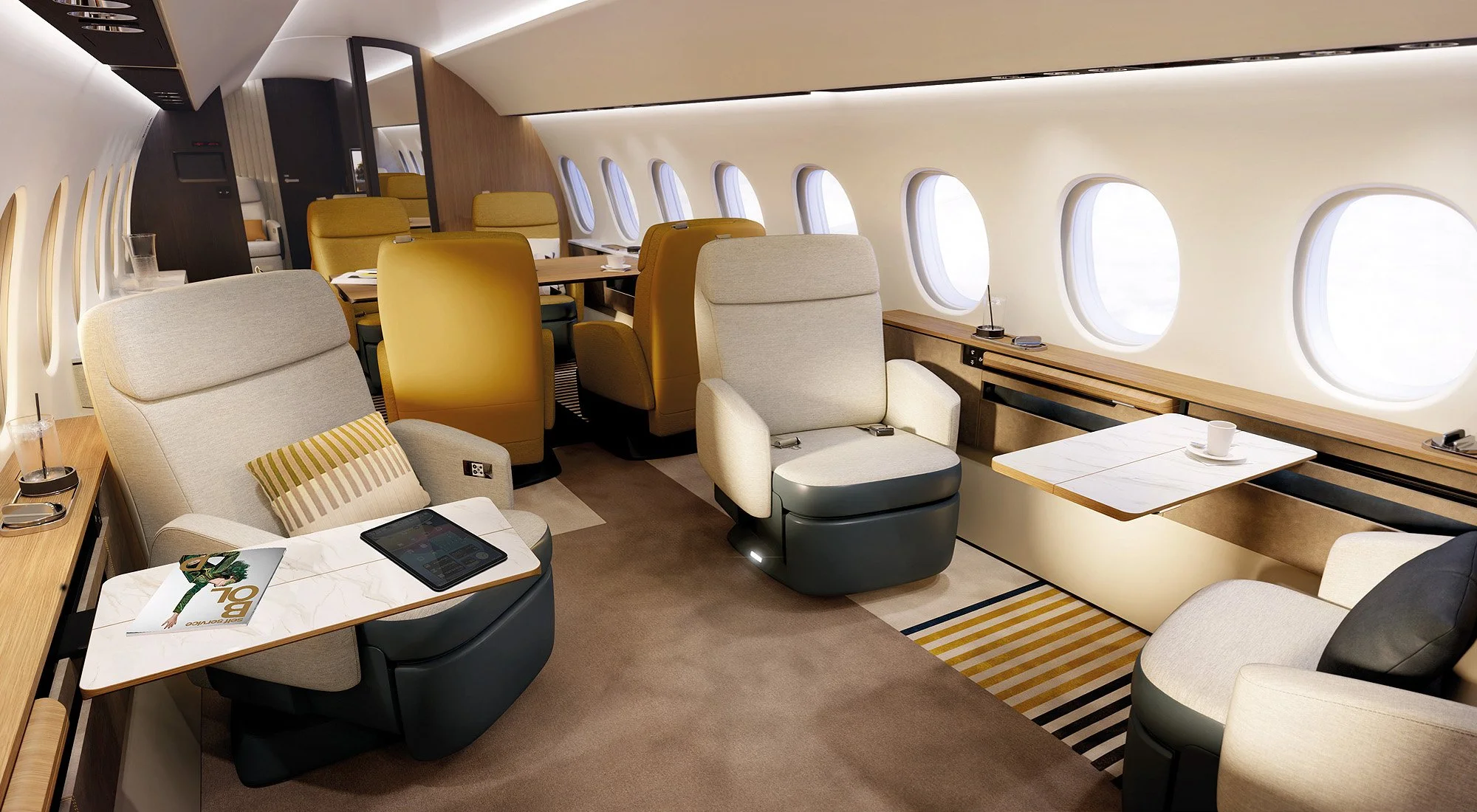
The 10X cabin is 9 feet 1 inch wide and 6 feet 8 inches tall. The Global 8000 and G800 are both 8 feet 2 inches wide; the Global 8000 is 6 feet 2 inches tall and the G800 is 6 feet 3 inches tall. The 10X is 11 inches wider and 5 to 6 inches taller than either competitor. At 53 feet 10 inches, the cabin is also the longest in the comparison, although the Global 8000 comes close at approximately 53 to 54 feet. The G800 is 46 feet 9 inches, roughly 7 feet shorter than both.
© Dassault Aviation
Those dimensions matter in practice. A wider and taller cabin allows configurations that are simply not possible in a narrower fuselage. A true full-width bedroom, a full-height shower room, a conference area, and a forward lounge can all coexist in the 10X without each zone feeling compromised. In the G800's shorter, narrower cabin, fitting that combination requires trade-offs in zone size. The Global 8000 can get close on configuration given its length, but the cross-section disadvantage limits what a designer can do within each zone.
The 10X cabin altitude at FL410 is projected at approximately 3,000 feet, slightly higher than both certified competitors. Dassault has paired the cabin with 38 extra-large windows—roughly double the count of either competitor—and a 100% fresh-air system with ozone and VOC filtration. The window count, at that size, produces a noticeably different light environment in the cabin than the 16-window configurations on the G800 and Global 8000.
Engines and Wing
The 10X is powered by two Rolls-Royce Pearl 10X engines built on the Advance2 core, developed specifically for this application. Each produces over 18,000 pounds of thrust. This is not an adapted engine from another program; Rolls-Royce built it for the 10X. Both engines are certified for 100% SAF operation.
The wing is the first all-composite wing ever fitted to a Dassault business jet—a high-sweep, high-aspect-ratio carbon fiber structure with a four-slat, two-large-flap, six-spoiler high-lift package. The composite construction reduces structural weight and allows the aerodynamic profile that produces both the field performance numbers and the efficiency required for a 7,500 nm mission. The technology draws directly from Dassault's Rafale fighter program, where composite wing construction has decades of operational history.
Avionics
The NeXus flight deck uses large touchscreen primary displays with Phase-of-Flight intelligence and a Digital Flight Control System with automated trim. The FalconEye Combined Vision System merges infrared Enhanced Vision with Synthetic Vision into a single fused image on dual Head-Up Displays, enabling approaches in conditions where pilots would otherwise lack usable visual references. Both pilot seats berth flat for rest, and a Crew Monitoring System tracks alertness on extended missions. On a 15-hour flight, that operational infrastructure is not a luxury feature.
Falcon 10X Full Specifications
II: Bombardier Global 8000
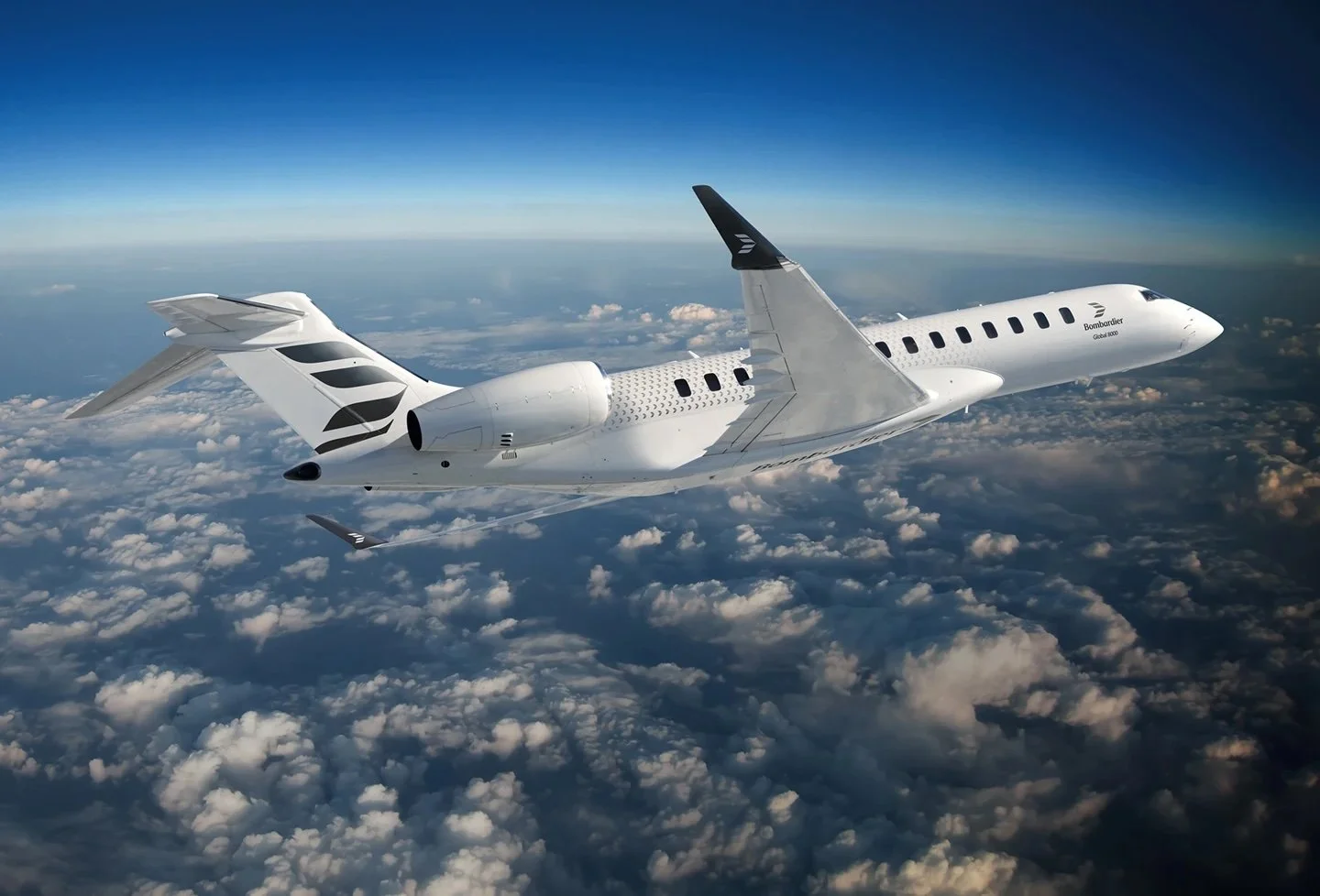
© Bombardier
Background
The Global 8000 has an unusual development history. Bombardier first announced a Global 8000 in 2010 as a shorter companion to what became the Global 7500. That program was shelved. The aircraft was reannounced in May 2022 at EBACE in Geneva as a longer-range, higher-speed evolution of the Global 7500, leveraging the existing airframe, transonic wing, and production infrastructure rather than starting clean-sheet. Development costs were a fraction of what a new design would require, and—critically—existing Global 7500 operators can convert their aircraft to Global 8000 configuration through approximately a one-week service bulletin. That upgrade path is commercially significant: it extends the installed base of the 8000 platform from the moment of first delivery.
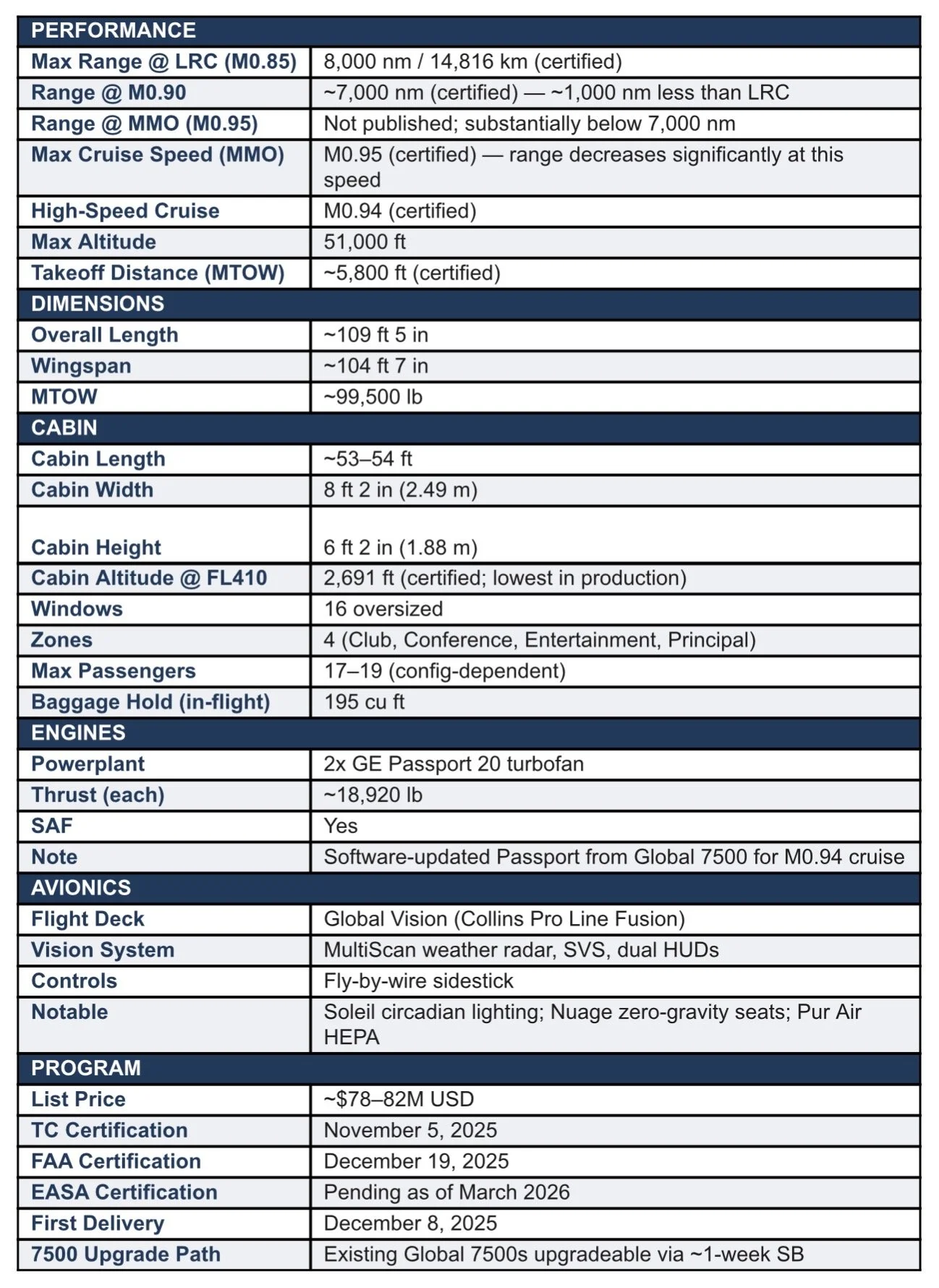
The Global 8000 received Transport Canada type certification on November 5, 2025, FAA certification on December 19, 2025, and EASA certification was pending as of March 2026. The first aircraft was delivered December 8, 2025, to Canadian entrepreneur Patrick Dovigi, who replaced his Global 7500 with it. Bombardier describes the Global 8000 as the fastest civil aircraft since the retirement of Concorde in 2003.
Performance
The headline number on the Global 8000 is speed. Its certified MMO is Mach 0.95, with a high-speed cruise of Mach 0.94. That is faster than either competitor: the G800 is certified at Mach 0.935 MMO, and the 10X is projected at Mach 0.925. Those speeds come at a range cost, as they do on every jet. The 8000's maximum certified range of 8,000 nm is achievable only at long-range cruise, roughly Mach 0.85. At Mach 0.90, Bombardier publishes approximately 7,000 nm—about 1,000 nm less than LRC. At MMO of Mach 0.95, the range drops further; Bombardier has not published a specific figure for full MMO cruise, but it is substantially below 7,000 nm. You get the speed or the range, not both at once.
Within that trade-off, the speed advantage is still meaningful on the right missions. On a 7,000 nm sector flown at Mach 0.90, the 8000 saves roughly 45 minutes to an hour over the G800 at the same speed, and more versus the 10X. Bombardier estimates approximately 1.5 hours of savings versus a Mach 0.80 cruise on long-haul sectors. For operators running high-priority trips where trip time is the primary metric and the mission fits within the aircraft's range at that cruise speed, that advantage is real and repeatable.
During the certification flight test program, a Global 8000 test vehicle briefly exceeded Mach 1.0 in a controlled shallow dive, making it the first business jet to break the sound barrier in testing. That does not translate to an operational claim, but it demonstrates the aerodynamic margin Bombardier built into the design.
Certified maximum range at long-range cruise is 8,000 nm, which trails the G800's 8,200 nm but substantially exceeds the 10X's 7,500 nm projection. The Global 8000 can connect New York to Hong Kong and Los Angeles to Singapore nonstop at LRC. For pure range, the G800 leads this comparison. For speed on missions within 7,000 nm, the Global 8000 is the most capable aircraft available.
Cabin
The Global 8000 shares the Global 7500's fuselage cross-section: 8 feet 2 inches wide and 6 feet 2 inches tall. That matches the G800 on width and is one inch shorter in height. The cross-section comparison with the 10X is where the Global 8000 and G800 are in the same category—both are 11 inches narrower and 5 to 6 inches shorter than the 10X.
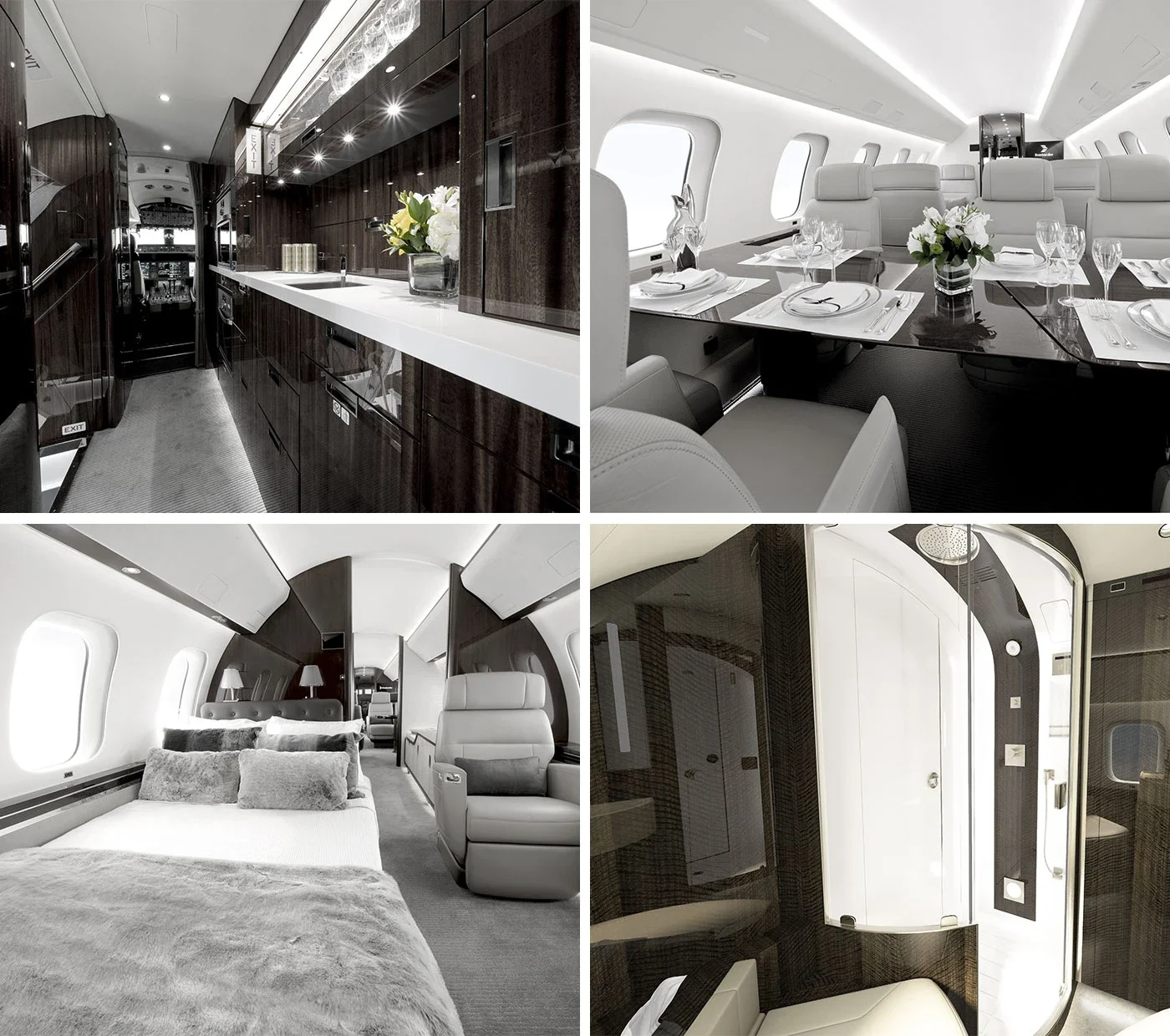
© Bombardier
Where the Global 8000 holds a concrete advantage over the G800 is length. At approximately 53 to 54 feet, the 8000's cabin is roughly 7 feet longer than the G800's 46 feet 9 inches. That length difference is what allows the Global 8000 to offer a full four-zone layout—Club Suite, Conference Suite, Entertainment Suite, and Principal Suite—with each zone having genuine usable space. The Principal Suite includes a full-size bed and an available steam shower. The 195-cubic-foot baggage hold is accessible in flight at any altitude.
The Global 8000's certified cabin altitude of 2,691 feet at FL410 is the lowest of any business jet currently in production. Bombardier's Pür Air system uses hospital-grade HEPA filtration capturing 99.99% of particles, combined with activated carbon filtration for VOCs and odors. The Soleil lighting system is integrated with the FMS to dynamically adjust cabin lighting based on destination time zone, directly addressing circadian disruption on long east-west flights. The Nuage zero-gravity executive seats, seven years in development, are consistently cited by operators as among the best executive seats in business aviation.
Engines and Wing
The Global 8000 is powered by two GE Aerospace Passport 20 engines, each producing approximately 18,920 pounds of thrust. The Passport engine entered service in 2018 on the Global 7500 and has accumulated more than 600,000 flight hours across that fleet with a dispatch reliability rate of 99.9%. For the 8000, GE modified the engine's software to optimize performance across altitude, temperature, and pressure variables, enabling the higher cruise speed and extended range. Buyers are getting a powerplant with a deep operational track record, not a new engine in its first years of service.
The transonic wing is the same design used on the Global 7500, a swept aluminum-lithium alloy structure with leading-edge slats. Bombardier credits the slat configuration with enabling access to 30% more airports than its closest competitor, though that specific claim has not been benchmarked in a certified head-to-head context against the 10X's London City capability. The Smooth Flex Wing design provides passive turbulence dampening that Bombardier describes as the smoothest ride in the class; that characterization has consistent support from operators across the Global 7500 fleet.
Avionics
The Global Vision flight deck uses Collins Aerospace Pro Line Fusion avionics with four large primary displays, fly-by-wire sidestick controls, and dual HUDs. MultiScan weather radar with predictive windshear detection is standard. The cockpit supports all current PBN requirements including RNP AR approaches, allowing curved approach paths into constrained airports. The crew rest area is the most spacious in the comparison.
The Soleil lighting system's FMS integration is a practical operational feature on long flights. Rather than requiring crew to manually adjust cabin lighting, the system automatically executes a lighting schedule calibrated to help passengers adapt to the destination time zone throughout the flight. On a 14-hour New York to Singapore sector, that capability can make a measurable difference in how passengers function on arrival.
Global 8000 Full Specifications
III: Gulfstream G800
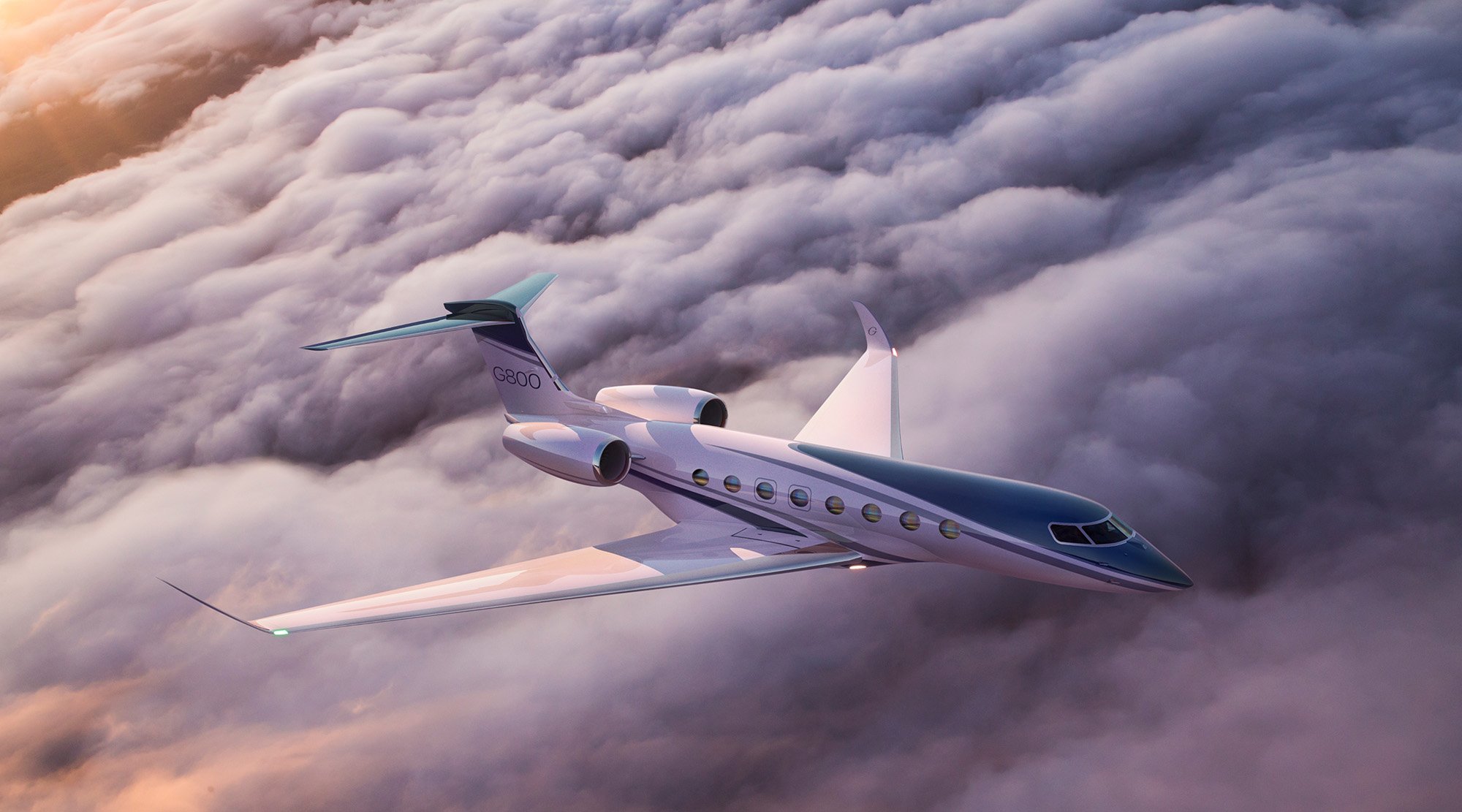
© Gulfstream Aerospace
Background
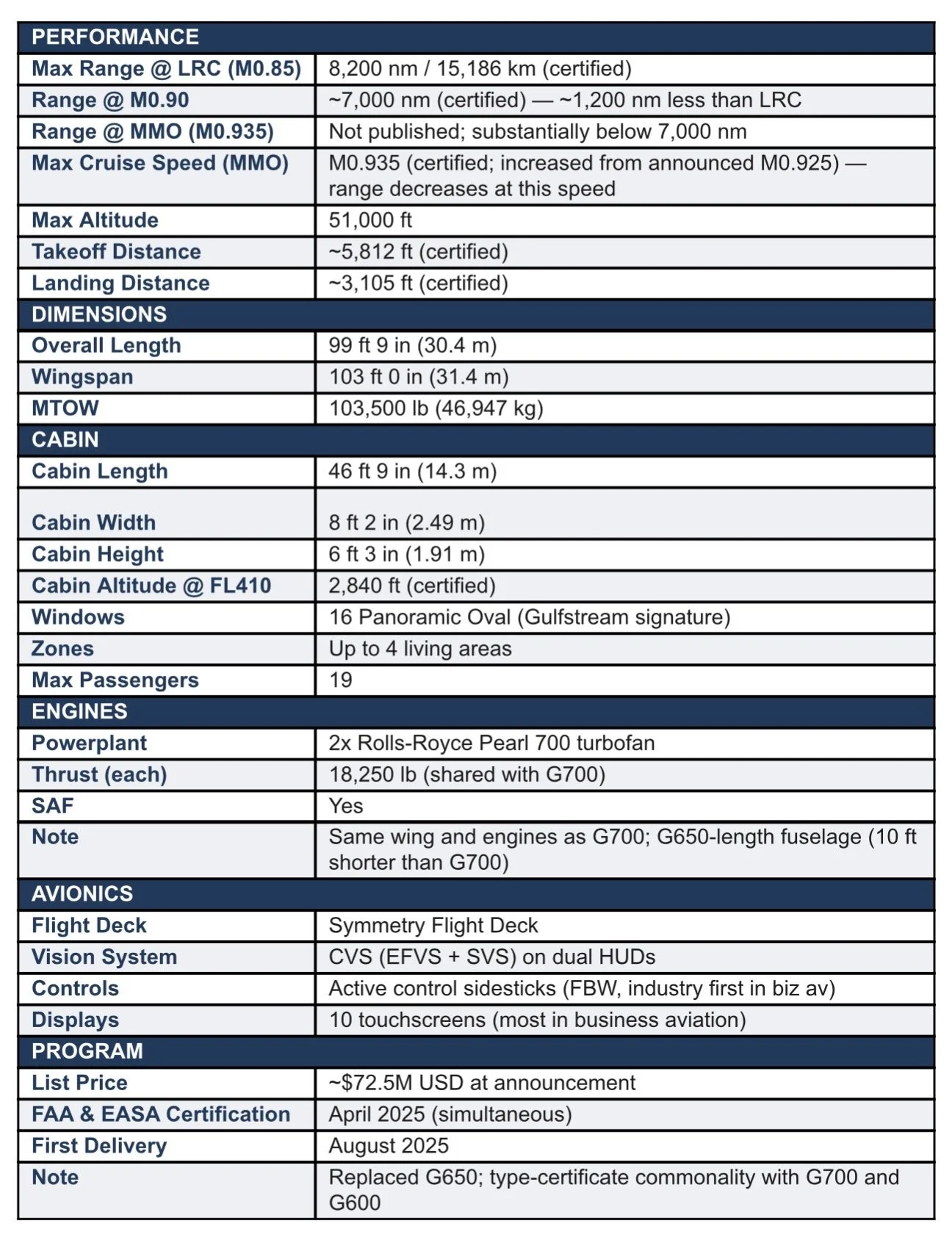
Gulfstream announced the G800 in October 2021 as the successor to the G650, which spent over a decade as the defining aircraft in the ultra-long-range segment and remains one of the most commercially successful large-cabin jets ever built. The G800 uses the G700's wing, winglets, and Pearl 700 engines in the G650's fuselage length. That platform decision gave Gulfstream an expedited development timeline and a 2022 first flight, resulting in FAA and EASA certification in April 2025 and first deliveries in August 2025. The G800 was first to market of the three by a substantial margin.
Two metrics came in better than originally announced: certified range increased from 8,000 nm to 8,200 nm, and maximum operating speed increased from the announced Mach 0.925 to a certified Mach 0.935. Buyers who had ordered based on the original specs received a better aircraft than they contracted for. The final G650 was completed in February 2025, completing the transition.
Performance
The G800's certified range of 8,200 nm at long-range cruise is the longest of the three aircraft. That figure is based on NBAA IFR reserves with eight passengers and four crew at roughly Mach 0.85—the standard industry comparison basis. It is not achievable at higher cruise speeds. At Mach 0.90, Gulfstream publishes approximately 7,000 nm, roughly 1,200 nm less than the LRC maximum. At MMO of Mach 0.935, the range drops further; Gulfstream has not published a specific figure at full MMO, but it is substantially below the Mach 0.90 number. The G800 connects Los Angeles to Sydney, London to Buenos Aires, and New York to Hong Kong nonstop—but only at long-range cruise speeds, not at high-speed cruise. The 700 nm range advantage over the 10X at LRC is real; it does not carry through to high-speed operations.
Maximum operating speed of Mach 0.935 is faster than the 10X's projected Mach 0.925 but slower than the Global 8000's certified Mach 0.95. At Mach 0.90—a practical high-speed cruise—the G800 covers approximately 7,000 nm and saves meaningful time over LRC on sectors exceeding 6,500 nm. The speed positioning puts the G800 between the other two aircraft: not the fastest, but faster than the 10X, and with more range reserve at high-speed cruise than the Global 8000 has at Mach 0.94.
Certified takeoff distance is approximately 5,812 feet and landing distance approximately 3,105 feet at MTOW. Field performance is comparable to the Global 8000 in practical terms; neither aircraft is designed or certified for the constrained-field operations the 10X targets with its London City capability.
Cabin
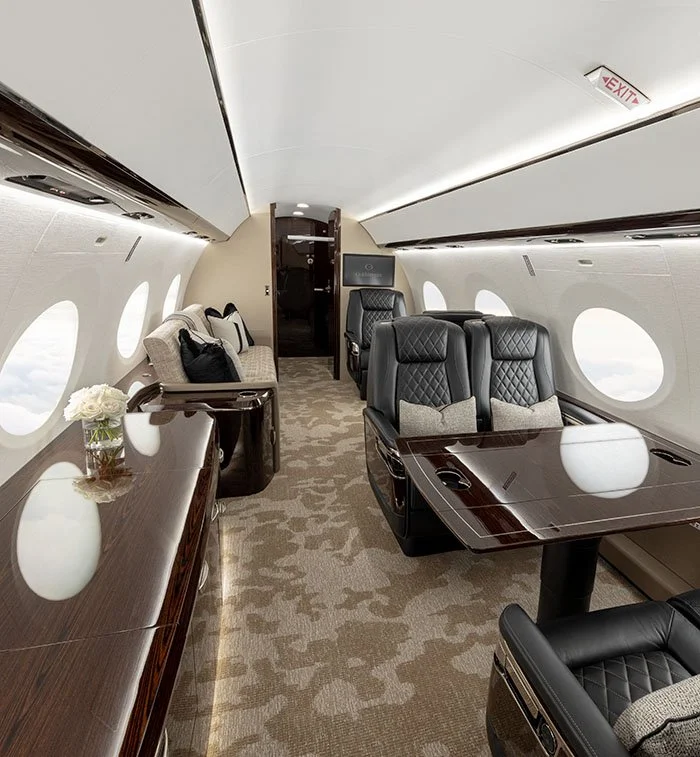
The G800 uses the G650 fuselage, 10 feet shorter than the G700's. Cabin length is 46 feet 9 inches—roughly 7 feet shorter than both the Global 8000 and the Falcon 10X. That gap is the G800's most significant competitive disadvantage in this comparison, and it is a direct consequence of the platform decision rather than an engineering constraint. For buyers whose missions involve 8 to 10 passengers with moderate configuration requirements, the G800's cabin length is adequate. For buyers planning 15-passenger configurations with separate bedroom, shower, and full conference zones, the length becomes a limiting factor.
© Gulfstream Aerospace
On cross-section, the G800 essentially matches the Global 8000: 8 feet 2 inches wide, 6 feet 3 inches tall versus the 8000's 6 feet 2 inches. Gulfstream's 16 Panoramic Oval windows are among the largest in business aviation, and the company claims they admit more natural light than any competing aircraft. The certified cabin altitude of 2,840 feet at FL410 is competitive—below 3,000 feet, and second only to the Global 8000's 2,691 feet in this comparison.
The G800 supports up to four living areas, a private suite, full galley, and an optional shower. Maximum seating is 19, with 10 sleep positions. The 100% fresh-air system uses a plasma ionization air purification system. Configuration flexibility is genuine but constrained by the available length; a designer working in 46 feet 9 inches will make different trade-offs than one working in 53 to 54 feet.
Engines and Wing
The G800 is powered by two Rolls-Royce Pearl 700 engines, each producing 18,250 pounds of thrust, the same engines used on the G700. The Pearl 700 has been in service since the G700's entry and has an established operational track record. Type-certificate commonality between the G700 and G800 is a practical advantage for fleet operators: pilots type-rated on the G700 transition to the G800 with reduced requirements, and parts and maintenance logistics are shared. For a corporate flight department already operating G700s, the G800 is a natural addition without the full transitional overhead of an entirely new type.
The wing is a Gulfstream-designed aerodynamic structure with new winglets that Gulfstream credits with enabling the G800's range and speed performance to exceed initial projections at certification. The design is not shared with the G650; it is the same wing as the G700, which is a meaningfully more capable aerodynamic platform than the G650's wing.
Avionics
The Symmetry Flight Deck is Gulfstream's most operationally mature large-cabin cockpit, used across the G500, G600, G700, and now G800. Active control sidesticks provide tactile feedback between pilots for improved nonverbal crew coordination—a feature Gulfstream calls an industry first in business aviation. The system uses 10 touchscreen displays with Phase-of-Flight intelligence that adjusts the cockpit configuration to each phase of flight automatically, reducing pilot workload during critical periods. Dual HUDs display the Combined Vision System, which merges EFVS infrared imaging with SVS database imagery into a single fused image. This is Gulfstream's fourth generation of combined vision technology and has the deepest operational history of any similar system in business aviation.
Fleet commonality with the G700 and G600 has practical training and certification implications. An operator running G700s alongside G800s benefits from shared type certificate requirements, simplified crew scheduling, and a single avionics ecosystem. For large corporate flight departments, that commonality has real operational and economic value.
G800 Full Specifications
IV: Full Comparison at a Glance
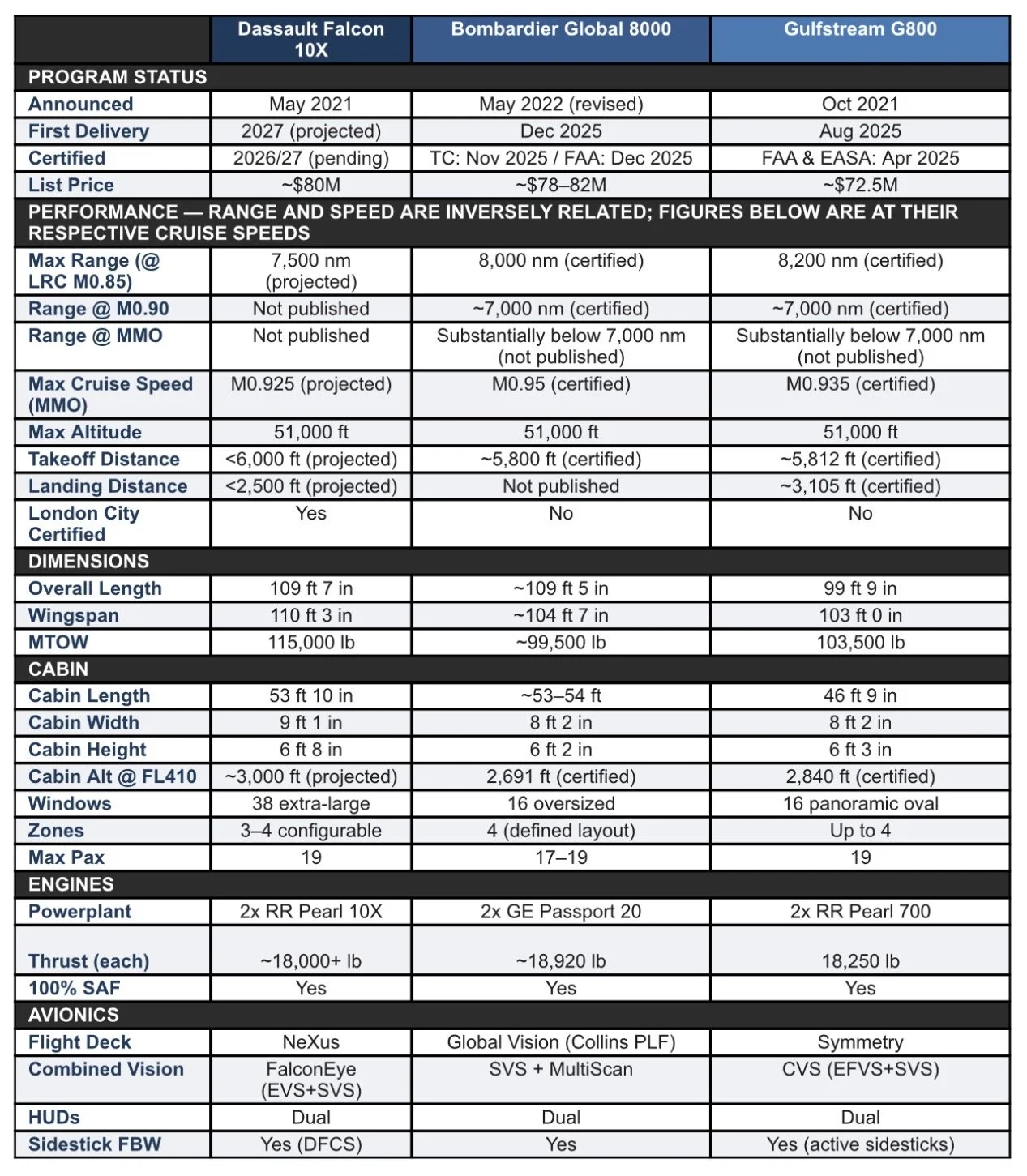
Falcon 10X specifications are manufacturer projections pending type certification. Global 8000 and G800 specs reflect certified production aircraft. Range figures based on NBAA IFR reserves, 8 pax, 4 crew at Mach 0.85 unless noted.
V: Head-to-Head Analysis
Range
Maximum range at long-range cruise (roughly Mach 0.85): G800 at 8,200 nm, Global 8000 at 8,000 nm, Falcon 10X projected at 7,500 nm. These numbers are not achievable at high-speed cruise—at Mach 0.90, both the G800 and the Global 8000 are certified at approximately 7,000 nm, a reduction of 1,000 to 1,200 nm from their LRC maximums. At MMO, the range drops further. Neither manufacturer has published an MMO range figure; it is substantially below the Mach 0.90 number for both aircraft. Dassault has not published any high-speed range figure for the 10X as of this writing.
The practical implication is this: if you need 8,000 nm of range, you are flying at long-range cruise speed, not high-speed cruise. You are not getting the G800's 8,200 nm and Mach 0.935 on the same mission. Buyers who need maximum range and buyers who need maximum speed are using two different performance envelopes on the same aircraft, and both are valid uses—but they are not simultaneous.
The 700 nm LRC range gap between the G800 and the 10X is operationally meaningful for specific city pairs. New York to Hong Kong is approximately 8,054 nm; the 10X needs a technical stop or a different departure city at LRC. Los Angeles to Sydney is roughly 7,487 nm; the 10X can make it at LRC but with minimal margin. The Global 8000 and G800 handle those routes with reserve at LRC. For the majority of ultra-long-range mission profiles—transatlantic, Europe to Middle East, North America to Europe—7,500 nm is sufficient. Buyers should map their specific route set against all three range figures before treating range as a deciding factor.
Speed
The Global 8000 leads this comparison clearly on maximum speed: Mach 0.95 MMO, Mach 0.94 high-speed cruise. The G800 is certified at Mach 0.935 MMO. The 10X is projected at Mach 0.925. The important context, as discussed above, is that these high speeds come with meaningful range reductions. At Mach 0.90, both the G800 and Global 8000 are at approximately 7,000 nm—well within the range where the speed advantage is operationally usable without running out of airplane.
On a 7,000 nm mission flown at Mach 0.90, the Global 8000 at Mach 0.94 saves approximately 45 minutes to an hour over the 10X at its projected cruise speed. Between the Global 8000 and the G800 at Mach 0.90, the difference is roughly 20 to 30 minutes on a long sector. For operators where trip time efficiency is the primary driver on high-priority missions, and those missions fit within the 7,000 nm range envelope at high-speed cruise, the Global 8000 wins this category. For operators whose primary concern is the cabin environment over 14 to 15 hours at LRC—where all three aircraft are flying at broadly similar speeds—the speed differential matters less.
Cabin Width and Volume
The Falcon 10X wins this comparison. Nine feet one inch wide, 6 feet 8 inches tall, 53 feet 10 inches long. The extra width and height enable configurations the other two aircraft cannot match. The Global 8000 is competitive on length but matches the G800 on cross-section. The G800 is the smallest cabin in the comparison, shorter by roughly 7 feet than its two competitors.
For buyers planning long missions with full passenger complements who want the widest possible configuration options, the 10X's dimensional advantage is structural and exclusive. It's not a close call on the width and height comparison.
Cabin Altitude
Global 8000 at 2,691 feet (certified), G800 at 2,840 feet (certified), 10X projected at approximately 3,000 feet. All three are well below the typical industry standard of 4,000 to 6,000 feet for aircraft in this class. The Global 8000 leads, but the practical difference between 2,691 and 3,000 feet is less significant than the difference between any of these three and the broader market norm. On a 14-hour flight, all three aircraft deliver a meaningfully better physiological environment than most alternatives.
Airport Access
The Falcon 10X holds an exclusive advantage. London City certification requires a 5.5-degree approach and short-field performance at a level no other aircraft in this comparison achieves or has sought. The 10X's projected landing distance of under 2,500 feet compares to the G800's certified 3,105 feet and the Global 8000's unpublished certified landing distance. Bombardier claims leading-edge slat technology gives the 8000 access to 30% more airports than its nearest rival, but that specific comparison has not been benchmarked in a certified head-to-head context against the 10X's London City capability.
For most buyers in this market, London City access is a secondary concern at best. The airport handles around 4.5 million passengers annually and is convenient for central London access. For operators who regularly serve the City of London financial district, the 10X's LCY capability is an exclusive operational feature. It is not replicable by the other two aircraft without a fundamental airframe redesign.
Program Maturity and Service Network
The G800 and Global 8000 are certified, in service, and accumulating flight hours. Both manufacturers have global service networks, established maintenance programs, type-rated pilot communities, and parts ecosystems in place. The G800 benefits from fleet commonality with the G700 and G600 and from Gulfstream's deep North American operator base. The Global 8000 benefits from the Global 7500's existing service network and the upgrade path that effectively creates an installed base of 8000-configuration aircraft from day one.
The Falcon 10X is approximately a year from first delivery and two to three years from meaningful fleet accumulation. Dassault has an established global service network for the Falcon line and has invested explicitly in 10X-specific support infrastructure. But buyers who need a certified aircraft available in 2025 or 2026 are deciding between the G800 and Global 8000. The 10X is a 2027 decision.
The Global 8000's EASA certification was still pending as of March 2026. European-based operators or operators with significant European route structures may prefer the G800, which holds both FAA and EASA certification.
Price
The G800 launched at $72.5 million, making it the most accessible entry point of the three at announcement. The Global 8000 lists between $78 million and $82 million across various sources; $78 million is the most frequently cited factory list price as of mid-2025. The 10X is projected at approximately $80 million. The spread is roughly $10 million across all three, which at this investment level is not a primary driver. Buyers at $80 million are not optimization-shopping; they are matching capability to mission.
Operating cost is where the ongoing numbers matter, and all three aircraft will run in a comparable range given their similar size and mission profiles. Detailed operating cost data for the 10X will develop as the aircraft accumulates hours post-certification. For the G800 and Global 8000, operators and management companies can begin building real cost data now.
VI: Choosing the Right Aircraft
The three aircraft serve the same market but have genuinely different strengths. The right choice depends on which of those strengths match a specific operation.
The Falcon 10X is the right choice if:
Your primary concern is the cabin environment on 12-to-15-hour flights, and you need the widest and most configurable cabin available. You regularly use London City Airport or other constrained airports that require the best short-field landing performance in the class. Your typical route set falls within 7,500 nm. You can plan for a 2027 delivery and are comfortable with a jet that has not yet completed certification as of this writing.
The Global 8000 is the right choice if:
Speed is a primary mission requirement on trips within 7,000 nm at high-speed cruise, and you want the fastest certified business jet in production. You understand that the 8,000 nm maximum range is achievable only at long-range cruise, not at the high cruise speeds the aircraft is capable of—and that trade-off works for your operation. You want the lowest certified cabin altitude in the class at 2,691 feet. Cabin length of approximately 53 to 54 feet is important to your configuration requirements. You are a North American operator or can tolerate the pending EASA certification timeline. You own a Global 7500 and want a direct upgrade path.
The G800 is the right choice if:
You need a certified aircraft available in 2025 or 2026. You want the longest certified range in the class at 8,200 nm at long-range cruise, understanding that this figure applies at Mach 0.85—not at high-speed cruise speeds. The G800's combination of maximum LRC range and a competitive high-speed cruise envelope gives you the most flexibility across both ends of the performance spectrum. You value type-certificate commonality with the G700 or G600 for fleet efficiency and simplified crew training. Your configuration requirements fit within 46 feet 9 inches of cabin length. You want the most operationally mature platform with the deepest service infrastructure available today. Simultaneous FAA and EASA certification matters to your operation.
This is also worth stating plainly: any buyer who selects one of these three aircraft is purchasing a genuinely excellent machine. The competition at the top of this market is real, and it is pushing each manufacturer to defend every specification. The buyers in this segment benefit from that competition regardless of which aircraft they ultimately choose.
Sources
G800: Gulfstream Aerospace FAA/EASA certification press release (April 2025); General Dynamics investor relations press release (April 2025); AOPA (April 2025); Flying Magazine (October 2025); Guardian Jet spec data; Wikipedia G650/G700/G800 article.
Global 8000: Bombardier FAA certification press release (December 2025); Bombardier Transport Canada certification announcement (November 2025); GE Aerospace Passport 20 certification announcement (August 2025); GE Aerospace Press Release on 500th Passport Engine; AeroTime (December 2025); Business Jet Traveler (April 2025); Wikipedia Bombardier Global 7500 article.
Falcon 10X: Dassault Aviation rollout materials (March 2026); Scissortail Knowledge Hub Falcon 10X article (March 2026). All 10X specifications are manufacturer projections pending type certification.
