
Dassault Rolls Out the Falcon 10X
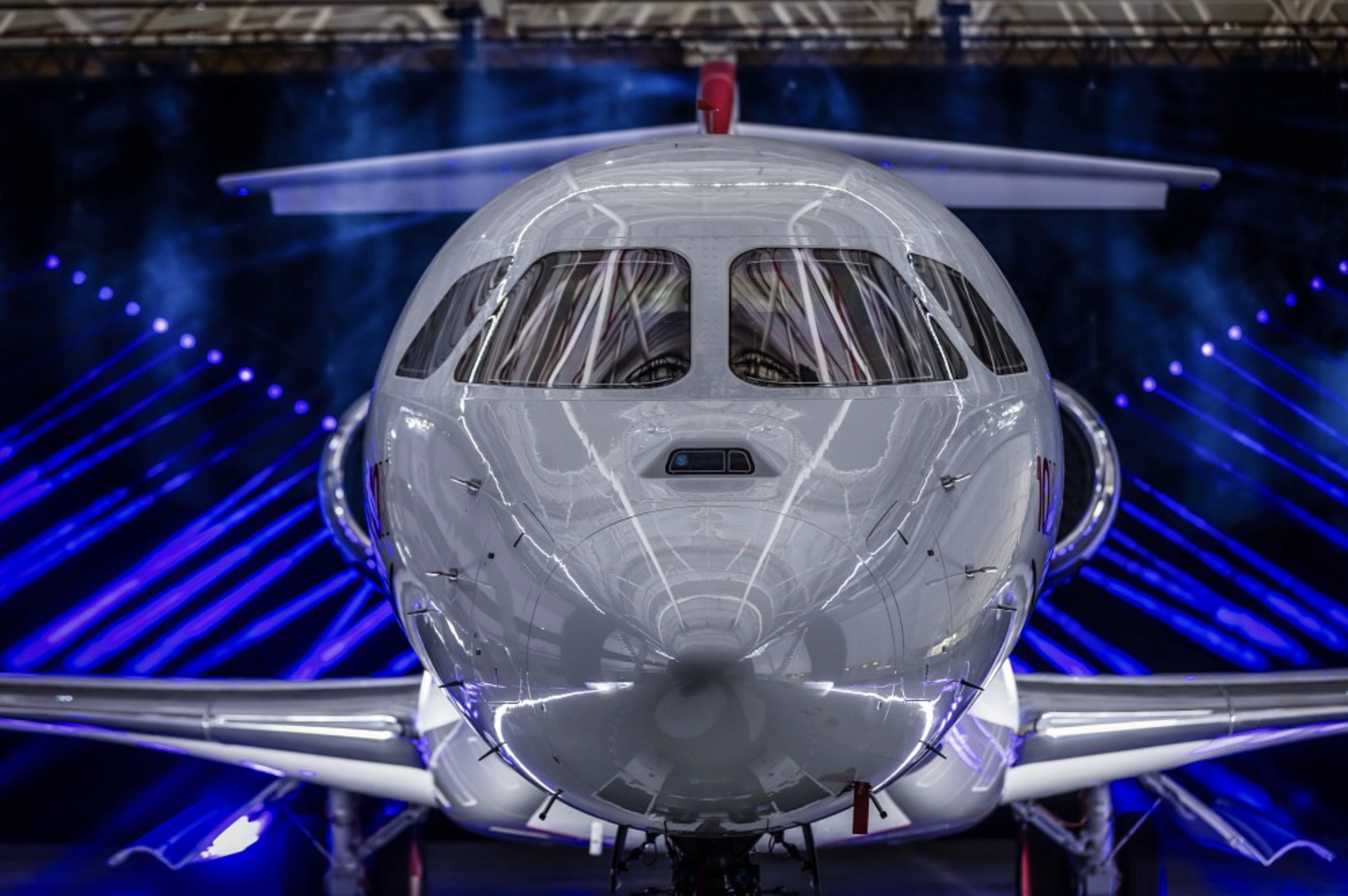
© Dassault Aviation - G. Gosset | Dassault Aviation Merignac, France.
Bordeaux-Merignac, France
On March 10, 2026, Dassault Aviation rolled out the Falcon 10X at its final assembly facility in Bordeaux-Merignac before more than 400 customers, partners, and industry guests. The aircraft had been announced in May 2021, a moment when the private aviation market was in the middle of one of its strongest demand cycles on record, with order books lengthening across the board and used aircraft values running well above historical norms. Dassault read that moment correctly and committed to a clean-sheet ultra-long-range flagship to go after the top of the market.
Five years later, here it is. First deliveries are now set for 2027, about two years behind the original target. Clean-sheet programs slip; that's a fact of life in this business. The more relevant question is whether the airplane was worth building, and based on what Dassault showed in Bordeaux, the answer appears to be yes.
The 10X is aimed squarely at the Bombardier Global 8000 and the Gulfstream G800. Both are exceptional aircraft. The 10X's argument against both of them starts with the cabin.
Pricing and Delivery
List Price: $80 million USD
First Delivery: 2027 (revised from original 2025 target)
Estimated Operating Cost: Approximately $2,000 to $3,000 per flight hour (owner-operator estimate)
Dassault has not released an order backlog figure. The corporate travel segment is expected to represent the majority of sales, with private owners and government customers accounting for the remainder. At $80 million, the 10X is priced in line with the Global 8000 (which launched around $78 million) and the G800. Early delivery positions for 2027 are already placed; buyers interested in near-term delivery should contact their broker now to understand availability.
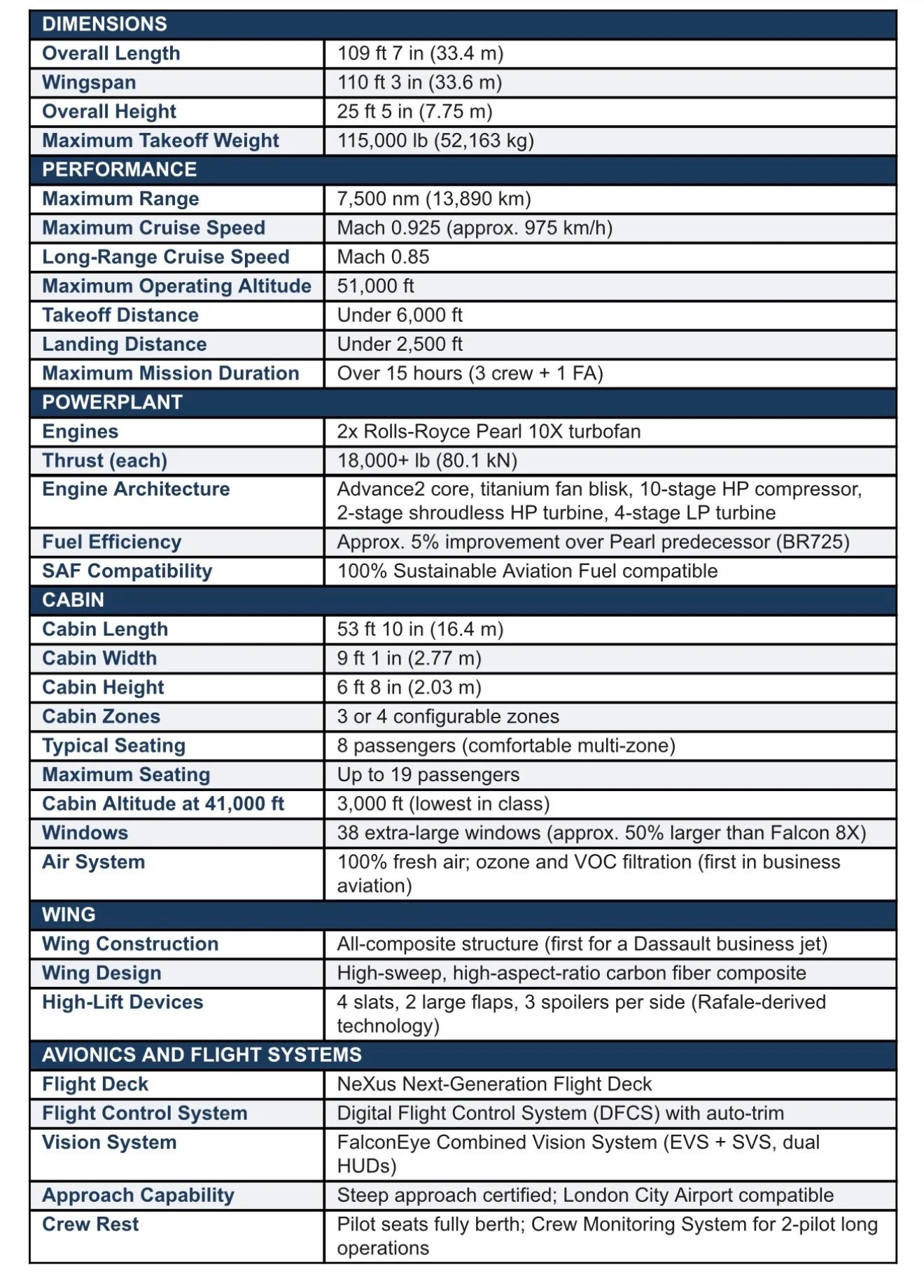
Full Specifications
What Sets the 10X Apart
A few characteristics distinguish the 10X from its direct competitors. Some are incremental improvements over what the class already offers. A few are genuinely new. Here's what's worth paying attention to.
Cabin Width and Height
The 10X cabin is 9 feet 1 inch wide and 6 feet 8 inches tall, which is about 8 inches wider and 2 inches taller than any other purpose-built business jet. At those dimensions, you can configure three or four distinct zones including a full-size bedroom, a shower, a private suite, and a proper dining area, all in the same airplane without compromising usable space in any of them. For operators doing 12-to-15-hour missions with owners or executives who need to arrive functional, the cabin cross-section is the most practical argument for the 10X.
Cabin Altitude and Air Quality
At a cruising altitude of 41,000 feet, the 10X holds a cabin altitude of 3,000 feet. Most jets in this class hold between 4,000 and 6,000 feet. On a long flight, that difference is felt. Lower cabin altitude reduces the physiological effects of mild hypoxia that contribute to fatigue and dehydration. Dassault has also added ozone and VOC filtration to the air system, which they describe as a first for business aviation. The cabin runs on 100% continuous fresh air exchange. These are real engineering achievements, and they show up in how passengers feel on arrival.
All-Composite Wing and Airport Access
The 10X uses the first all-composite wing ever fitted to a Dassault business jet. It's a high-sweep, high-aspect-ratio carbon fiber structure with high-lift devices derived from the Rafale fighter program. The result is a takeoff distance under 6,000 feet and a landing distance under 2,500 feet on a full intercontinental jet. That opens up airports that the Global 8000 and G800 cannot access, including London City Airport with its 5.5-degree approach. If your operation uses smaller or more challenging fields, that's a practical advantage worth quantifying against your specific route set.
Rolls-Royce Pearl 10X Engines
The Pearl 10X is a purpose-built engine developed by Rolls-Royce specifically for this aircraft, built on the Advance2 core. Each engine produces over 18,000 pounds of thrust and delivers roughly 5% better fuel efficiency than its predecessor in the Pearl family. Both engines are certified for 100% SAF operation. Dassault has historically used GE and Pratt & Whitney powerplants across the Falcon line; the move to Rolls-Royce for the 10X reflects the Pearl series' performance credentials at this thrust level.
NeXus Flight Deck and FalconEye
The NeXus cockpit uses large touchscreen primary displays, a Digital Flight Control System with automated trim, and dual Head-Up Displays with Dassault's FalconEye Combined Vision System. FalconEye merges infrared Enhanced Vision with database-generated Synthetic Vision into a single fused image on the HUDs, giving crews usable visual references in conditions that would otherwise require a diversion or alternate approach. The pilot seats berth flat for long-haul operations, and the Crew Monitoring System tracks crew alertness when one pilot is resting. For two-pilot operations on 15-hour missions, those features are operationally meaningful.
How It Compares to the Competition
The Bombardier Global 8000 carries an 8,000 nm range versus the 10X's 7,500 nm, so Bombardier holds that edge. The Gulfstream G800 is comparable to the 10X on range. Neither competitor matches the 10X on cabin width. All three aircraft are priced within a few million dollars of each other at list. For operators whose missions fall within 7,500 nm, the 10X's cabin environment and airport access flexibility make it a compelling option. For operations that regularly push beyond that range, the Global 8000 deserves a side-by-side look. More on this in a later artic
Summary for Buyers and Operators
The Falcon 10X enters service in 2027 as one of three top-tier options in the ultra-long-range large-cabin segment. Its cabin width and altitude specs are class-leading. The composite wing gives it airport access that neither the G800 nor the Global 8000 can match. The Pearl 10X engines are efficient and fully SAF-compatible. The NeXus avionics suite is among the most capable cockpit environments available in business aviation today.
The program slipped approximately two years from its original delivery schedule, which is worth noting for buyers who placed early orders and have been waiting. With certification work progressing through 2026, 2027 deliveries appear realistic at this point.
At $80 million list, the 10X is priced where you'd expect a jet of this specification to land. If your operation demands maximum range above 7,500 nm, look at the Global 8000. If cabin environment, air quality, and field flexibility are the priorities, the 10X has a strong case. Either way, the competition at the top of this market is good for buyers, and the 10X raises the bar in ways the other manufacturers will have to respond to.
For more information directly from Dassault, CLICK HERE.
